|
|
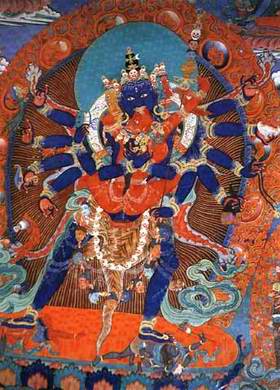
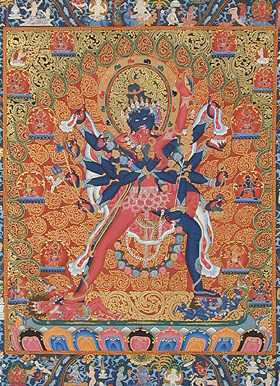
Cakrasamvara has four faces and twelve arms. His first two arms are wrapped in passionate embrace around his consort, Vajravarahi. The first two hands, holding a vajra scepter and a bell, make the diamond HUM-sound gesture. In Tibet, Cakrasamvara is a deity particularly associated with the
Kagyu Order, although he is important to the Geluk and Sakya as well.
His body is blue, indicating that he does not diverge from the (celestial) Dharma-sphere. Each face has three eyes, indicating that he sees the (whole) threefold world and that he knows the substance of the three times (past, present and future). He has twelve arms indicating that he comprehends the evolution and reversal of the twelvefold causal nexus and eliminates these twelve stages of transmigration. The first pair of hands holds, right and left, a vajra scepter and a bell, symbolizing the union of skillful means and wisdom. The second pair rends the elephant of illusion and stretches its hide out like a cape. The drum in the third right hand (missing) shows that Cakrasamvara's "voice resounds joyously." The third left hand holds the khatvanga staff that represents "the blissful Thought of Enlightenment." His fourth right hand brandishes the ax (missing) that "cuts off birth and death at the roots." The skull bowl of blood in his fourth left hand shows that he "has cut away discrimination between existence and nonexistence." His fifth right hand wields the vajra chopper that "cuts off the six defects, pride and the rest." The vajra lasso in his fifth left hand binds beings to wisdom from life to life. The trident (missing) in his sixth right hand signals that he has "overcome the evil of the threefold world." The severed head of the god Brahma dangles from his sixth left hand, showing that Cakrasamvara "avoids all illusion."
Source: http://www.holymtn.com/gods/TantricGods.htm
|